NODEBB: Nginx error performance & High CPU

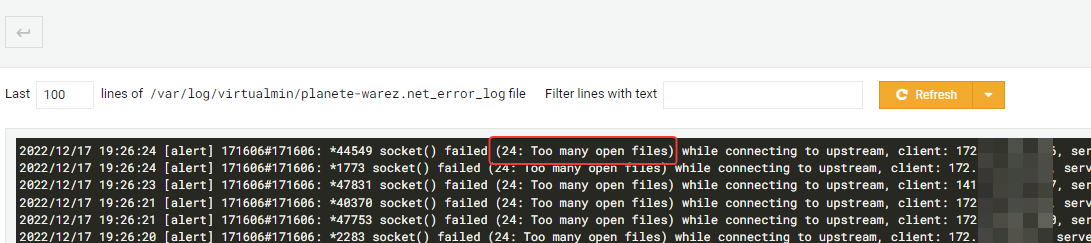
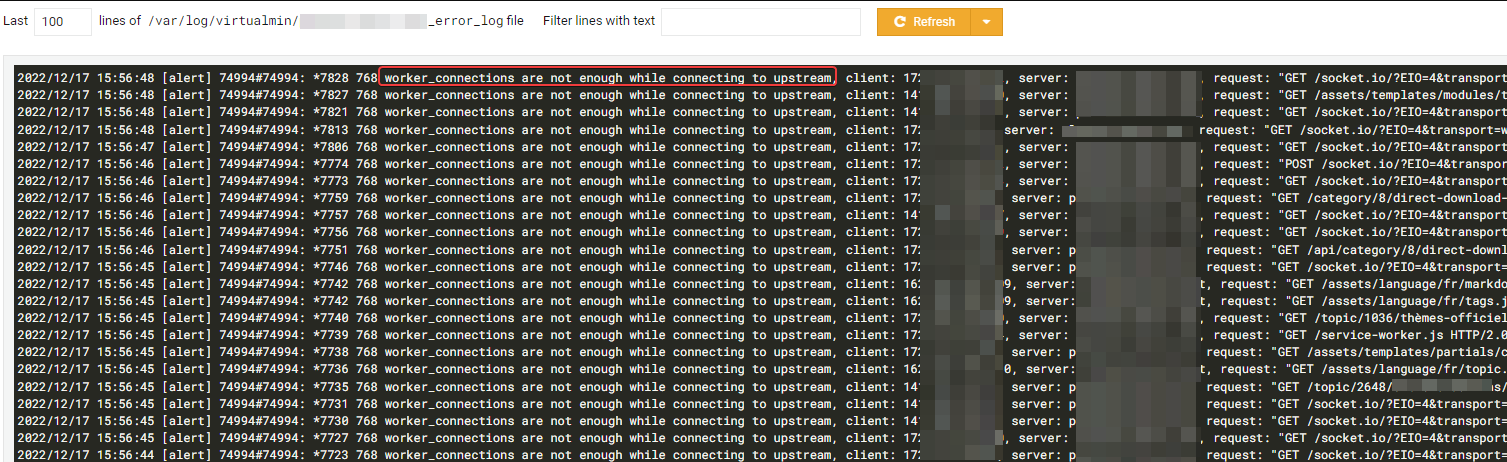

-
@phenomlab said in NODEBB: Nginx error performance & High CPU:
@DownPW It’s more straightforward than it sounds, although can be confusing if you look at it for the first time. I’ve just implemented it here. Can you provide your
nginxconfig and yourconfig.json(remove password obviously)Thanks
here is my nginx.conf
user www-data;
worker_processes auto;
pid /run/nginx.pid;
worker_rlimit_nofile 70000;
include /etc/nginx/modules-enabled/*.conf;

events {
	# worker_connections 768;
	worker_connections 4000;
	#multi_accept on;
	#multi_accept on;
}

http {

	##
	# Basic Settings
	##

	#client_max_body_size 10M;

	#Requete maximun par ip
	limit_req_zone $binary_remote_addr zone=flood:10m rate=100r/s;

	#Connexions maximum par ip
	limit_conn_zone $binary_remote_addr zone=ddos:1m;

	sendfile on;
	tcp_nopush on;
	tcp_nodelay on;
	keepalive_timeout 65;
	types_hash_max_size 2048;
	# server_tokens off;

	# server_names_hash_bucket_size 64;
	# server_name_in_redirect off;

	include /etc/nginx/mime.types;
	default_type application/octet-stream;

	##
	# SSL Settings
	##

	ssl_protocols TLSv1 TLSv1.1 TLSv1.2 TLSv1.3; # Dropping SSLv3, ref: POODLE
	ssl_prefer_server_ciphers on;

	##
	# Logging Settings
	##

	access_log /var/log/nginx/access.log;
	error_log /var/log/nginx/error.log;

	##
	# Gzip Settings
	##

	gzip on;

	gzip_min_length 1000; #test Violence
	gzip_proxied off; #test Violence
	gzip_types text/plain application/xml text/javascript application/javascript application/x-javascript text/css application/json;

	# gzip_vary on;
	# gzip_proxied any;
	# gzip_comp_level 6;
	# gzip_buffers 16 8k;
	# gzip_http_version 1.1;
	# gzip_types text/plain text/css application/json application/javascript text/xml application/xml application/xml+rss text/javascript;

	##
	# Virtual Host Configs
	##

	include /etc/nginx/conf.d/*.conf;
	include /etc/nginx/sites-enabled/*;
	server_names_hash_bucket_size 128;
}


#mail {
#	# See sample authentication script at:
#	# http://wiki.nginx.org/ImapAuthenticateWithApachePhpScript
#
#	# auth_http localhost/auth.php;
#	# pop3_capabilities "TOP" "USER";
#	# imap_capabilities "IMAP4rev1" "UIDPLUS";
#
#	server {
#		listen     localhost:110;
#		protocol   pop3;
#		proxy      on;
#	}
#
#	server {
#		listen     localhost:143;
#		protocol   imap;
#		proxy      on;
#	}
#}
And my NodebB website.conf :
server {
	server_name XX-XX.net www.XX-XX.net;
	listen XX.XX.XX.X;
	listen [XX:XX:XX:XX::];
	root /home/XX-XX/nodebb;
	index index.php index.htm index.html;
	access_log /var/log/virtualmin/XX-XX.net_access_log;
	error_log /var/log/virtualmin/XX-XX.net_error_log;

        location / {

		limit_req zone=flood burst=100 nodelay;
		limit_conn ddos 10;
		proxy_read_timeout 180;

                proxy_set_header X-Real-IP $remote_addr;
                proxy_set_header X-Forwarded-For $proxy_add_x_forwarded_for;
                proxy_set_header Host $http_host;
                proxy_set_header X-NginX-Proxy true;

                proxy_pass http://127.0.0.1:4567/;
                proxy_redirect off;

                # Socket.IO Support
                proxy_http_version 1.1;
                proxy_set_header Upgrade $http_upgrade;
                proxy_set_header Connection "upgrade";
        }

	listen XX.XX.XX.XX:XXssl http2;
	listen [XX:XX:XX:XX::]:443 ssl http2;
	ssl_certificate /etc/ssl/virtualmin/166195366750642/ssl.cert;
	ssl_certificate_key /etc/ssl/virtualmin/166195366750642/ssl.key;
	if ($scheme = http) {
		rewrite ^/(?!.well-known)(.*) "https://XX-XX.net/$1" break;
	}
}
and my nodebb config.json :
{ "url": "https://XX-XX.net", "secret": "XXXXXXXXXXXXXXXX", "database": "mongo", "mongo": { "host": "127.0.0.1", "port": "27017", "username": "XXXXXXXXXXX", "password": "XXXXXXXXXXX", "database": "nodebb", "uri": "" } }@DownPW Change your
config.jsonso that it looks like the below{ "url": "https://XX-XX.net", "secret": "XXXXXXXXXXXXXXXX", "database": "mongo", "mongo": { "host": "127.0.0.1", "port": "27017", "username": "XXXXXXXXXXX", "password": "XXXXXXXXXXX", "database": "nodebb", "uri": "" }, "redis": { "host":"127.0.0.1", "port":"6379", "database": 5 }, "port": ["4567", "4568", "4569"] // will start three processes }Your
nginx.confalso needs modification (see commented steps for changes etc)# add the below block for nodeBB clustering upstream io_nodes { ip_hash; server 127.0.0.1:4567; server 127.0.0.1:4568; server 127.0.0.1:4569; } server { server_name XX-XX.net www.XX-XX.net; listen XX.XX.XX.X; listen [XX:XX:XX:XX::]; root /home/XX-XX/nodebb; index index.php index.htm index.html; access_log /var/log/virtualmin/XX-XX.net_access_log; error_log /var/log/virtualmin/XX-XX.net_error_log; # add the below block which will force all traffic into the cluster when referenced with @nodebb location @nodebb { proxy_pass http://io_nodes; } location / { limit_req zone=flood burst=100 nodelay; limit_conn ddos 10; proxy_read_timeout 180; proxy_set_header X-Real-IP $remote_addr; proxy_set_header X-Forwarded-For $proxy_add_x_forwarded_for; proxy_set_header Host $http_host; proxy_set_header X-NginX-Proxy true; # It's necessary to set @nodebb here so that the clustering works proxy_pass @nodebb; proxy_redirect off; # Socket.IO Support proxy_http_version 1.1; proxy_set_header Upgrade $http_upgrade; proxy_set_header Connection "upgrade"; } listen XX.XX.XX.XX:XXssl http2; listen [XX:XX:XX:XX::]:443 ssl http2; ssl_certificate /etc/ssl/virtualmin/166195366750642/ssl.cert; ssl_certificate_key /etc/ssl/virtualmin/166195366750642/ssl.key; if ($scheme = http) { rewrite ^/(?!.well-known)(.*) "https://XX-XX.net/$1" break; } }Mark Cutting also advises organisations as a Fractional CIO, Fractional CISO and Executive Advisor, helping boards improve technology governance, cyber resilience and executive decision making. Learn more at Phenomlab Ltd
-
@DownPW Change your
config.jsonso that it looks like the below{ "url": "https://XX-XX.net", "secret": "XXXXXXXXXXXXXXXX", "database": "mongo", "mongo": { "host": "127.0.0.1", "port": "27017", "username": "XXXXXXXXXXX", "password": "XXXXXXXXXXX", "database": "nodebb", "uri": "" }, "redis": { "host":"127.0.0.1", "port":"6379", "database": 5 }, "port": ["4567", "4568", "4569"] // will start three processes }Your
nginx.confalso needs modification (see commented steps for changes etc)# add the below block for nodeBB clustering upstream io_nodes { ip_hash; server 127.0.0.1:4567; server 127.0.0.1:4568; server 127.0.0.1:4569; } server { server_name XX-XX.net www.XX-XX.net; listen XX.XX.XX.X; listen [XX:XX:XX:XX::]; root /home/XX-XX/nodebb; index index.php index.htm index.html; access_log /var/log/virtualmin/XX-XX.net_access_log; error_log /var/log/virtualmin/XX-XX.net_error_log; # add the below block which will force all traffic into the cluster when referenced with @nodebb location @nodebb { proxy_pass http://io_nodes; } location / { limit_req zone=flood burst=100 nodelay; limit_conn ddos 10; proxy_read_timeout 180; proxy_set_header X-Real-IP $remote_addr; proxy_set_header X-Forwarded-For $proxy_add_x_forwarded_for; proxy_set_header Host $http_host; proxy_set_header X-NginX-Proxy true; # It's necessary to set @nodebb here so that the clustering works proxy_pass @nodebb; proxy_redirect off; # Socket.IO Support proxy_http_version 1.1; proxy_set_header Upgrade $http_upgrade; proxy_set_header Connection "upgrade"; } listen XX.XX.XX.XX:XXssl http2; listen [XX:XX:XX:XX::]:443 ssl http2; ssl_certificate /etc/ssl/virtualmin/166195366750642/ssl.cert; ssl_certificate_key /etc/ssl/virtualmin/166195366750642/ssl.key; if ($scheme = http) { rewrite ^/(?!.well-known)(.*) "https://XX-XX.net/$1" break; } }ok I have to talk to the staff members first before i do anything.
So there is nothing to put in the vhost XX-XX.net ?, everything is in the nginx.conf and the config.json if I understand correctly
In terms of disk space, memory, cpu what does it give ?
After all of that, we need to restart nodebb I imagine ?
These new ports (4567", “4568”, "4569) must also be open in the Hetzner interface?
I wanted all the details if possible
PW and WS Spirit alive
-
ok I have to talk to the staff members first before i do anything.
So there is nothing to put in the vhost XX-XX.net ?, everything is in the nginx.conf and the config.json if I understand correctly
In terms of disk space, memory, cpu what does it give ?
After all of that, we need to restart nodebb I imagine ?
These new ports (4567", “4568”, "4569) must also be open in the Hetzner interface?
I wanted all the details if possible
@DownPW said in NODEBB: Nginx error performance & High CPU:
everything is in the nginx.conf and the config.json if I understand correctly
Yes, that’s correct
@DownPW said in NODEBB: Nginx error performance & High CPU:
In terms of disk space, memory, cpu what does it give ?
There should be little change in terms of the usage. What clustering does is essentially provide multiple processes to carry out the same tasks, but obviously much faster than one process only ever could.
@DownPW said in NODEBB: Nginx error performance & High CPU:
After all of that, we need to restart nodebb I imagine ?
Correct
@DownPW said in NODEBB: Nginx error performance & High CPU:
These new ports (4567", “4568”, "4569) must also be open in the Hetzner interface?
Will not be necessary as they are not available publicly, but only to the reverse proxy on
127.0.0.1Mark Cutting also advises organisations as a Fractional CIO, Fractional CISO and Executive Advisor, helping boards improve technology governance, cyber resilience and executive decision making. Learn more at Phenomlab Ltd
-
@DownPW said in NODEBB: Nginx error performance & High CPU:
everything is in the nginx.conf and the config.json if I understand correctly
Yes, that’s correct
@DownPW said in NODEBB: Nginx error performance & High CPU:
In terms of disk space, memory, cpu what does it give ?
There should be little change in terms of the usage. What clustering does is essentially provide multiple processes to carry out the same tasks, but obviously much faster than one process only ever could.
@DownPW said in NODEBB: Nginx error performance & High CPU:
After all of that, we need to restart nodebb I imagine ?
Correct
@DownPW said in NODEBB: Nginx error performance & High CPU:
These new ports (4567", “4568”, "4569) must also be open in the Hetzner interface?
Will not be necessary as they are not available publicly, but only to the reverse proxy on
127.0.0.1OK.
I resume in details.
1- Stop nodebb
2- Stop iframely
3- Stop nginx
4- Install redis server : sudo apt install redis-server
5- Change nodebb Config.json file (can you verifiy this synthax please ? nodebb documentation tell “database”: 0 and not “database”: 5 - but maybe it’s just a name and i can use the same as mongo like “database”: nodebb , I moved the port directive) :{ "url": "https://XX-XX.net", "secret": "XXXXXXXXXXXXXXXX", "database": "mongo", "port": [4567, 4568,4569], "mongo": { "host": "127.0.0.1", "port": "27017", "username": "XXXXXXXXXXX", "password": "XXXXXXXXXXX", "database": "nodebb", "uri": "" }, "redis": { "host":"127.0.0.1", "port":"6379", "database": 5 } }6- Change nginx.conf :
# add the below block for nodeBB clustering upstream io_nodes { ip_hash; server 127.0.0.1:4567; server 127.0.0.1:4568; server 127.0.0.1:4569; } server { server_name XX-XX.net www.XX-XX.net; listen XX.XX.XX.X; listen [XX:XX:XX:XX::]; root /home/XX-XX/nodebb; index index.php index.htm index.html; access_log /var/log/virtualmin/XX-XX.net_access_log; error_log /var/log/virtualmin/XX-XX.net_error_log; # add the below block which will force all traffic into the cluster when referenced with @nodebb location @nodebb { proxy_pass http://io_nodes; } location / { limit_req zone=flood burst=100 nodelay; limit_conn ddos 10; proxy_read_timeout 180; proxy_set_header X-Real-IP $remote_addr; proxy_set_header X-Forwarded-For $proxy_add_x_forwarded_for; proxy_set_header Host $http_host; proxy_set_header X-NginX-Proxy true; # It's necessary to set @nodebb here so that the clustering works proxy_pass @nodebb; proxy_redirect off; # Socket.IO Support proxy_http_version 1.1; proxy_set_header Upgrade $http_upgrade; proxy_set_header Connection "upgrade"; } listen XX.XX.XX.XX:XXssl http2; listen [XX:XX:XX:XX::]:443 ssl http2; ssl_certificate /etc/ssl/virtualmin/166195366750642/ssl.cert; ssl_certificate_key /etc/ssl/virtualmin/166195366750642/ssl.key; if ($scheme = http) { rewrite ^/(?!.well-known)(.*) "https://XX-XX.net/$1" break; } }7- restart redis server systemctl restart redis-server.service
8- Restart nginx
9- Restart iframely
10- Restart nodebb
11- test configurationPW and WS Spirit alive
-
OK.
I resume in details.
1- Stop nodebb
2- Stop iframely
3- Stop nginx
4- Install redis server : sudo apt install redis-server
5- Change nodebb Config.json file (can you verifiy this synthax please ? nodebb documentation tell “database”: 0 and not “database”: 5 - but maybe it’s just a name and i can use the same as mongo like “database”: nodebb , I moved the port directive) :{ "url": "https://XX-XX.net", "secret": "XXXXXXXXXXXXXXXX", "database": "mongo", "port": [4567, 4568,4569], "mongo": { "host": "127.0.0.1", "port": "27017", "username": "XXXXXXXXXXX", "password": "XXXXXXXXXXX", "database": "nodebb", "uri": "" }, "redis": { "host":"127.0.0.1", "port":"6379", "database": 5 } }6- Change nginx.conf :
# add the below block for nodeBB clustering upstream io_nodes { ip_hash; server 127.0.0.1:4567; server 127.0.0.1:4568; server 127.0.0.1:4569; } server { server_name XX-XX.net www.XX-XX.net; listen XX.XX.XX.X; listen [XX:XX:XX:XX::]; root /home/XX-XX/nodebb; index index.php index.htm index.html; access_log /var/log/virtualmin/XX-XX.net_access_log; error_log /var/log/virtualmin/XX-XX.net_error_log; # add the below block which will force all traffic into the cluster when referenced with @nodebb location @nodebb { proxy_pass http://io_nodes; } location / { limit_req zone=flood burst=100 nodelay; limit_conn ddos 10; proxy_read_timeout 180; proxy_set_header X-Real-IP $remote_addr; proxy_set_header X-Forwarded-For $proxy_add_x_forwarded_for; proxy_set_header Host $http_host; proxy_set_header X-NginX-Proxy true; # It's necessary to set @nodebb here so that the clustering works proxy_pass @nodebb; proxy_redirect off; # Socket.IO Support proxy_http_version 1.1; proxy_set_header Upgrade $http_upgrade; proxy_set_header Connection "upgrade"; } listen XX.XX.XX.XX:XXssl http2; listen [XX:XX:XX:XX::]:443 ssl http2; ssl_certificate /etc/ssl/virtualmin/166195366750642/ssl.cert; ssl_certificate_key /etc/ssl/virtualmin/166195366750642/ssl.key; if ($scheme = http) { rewrite ^/(?!.well-known)(.*) "https://XX-XX.net/$1" break; } }7- restart redis server systemctl restart redis-server.service
8- Restart nginx
9- Restart iframely
10- Restart nodebb
11- test configuration@DownPW said in NODEBB: Nginx error performance & High CPU:
5- Change nodebb Config.json file (can you verifiy this synthax please ? nodebb documentation tell “database”: 0 and not “database”: 5,
All fine from my perspective - no real need to stop
iFramely, but ok. The database number doesn’t matter as long as it’s not being used. You can use0if you wish - it’s in use on my side, hence5. -
OK.
I resume in details.
1- Stop nodebb
2- Stop iframely
3- Stop nginx
4- Install redis server : sudo apt install redis-server
5- Change nodebb Config.json file (can you verifiy this synthax please ? nodebb documentation tell “database”: 0 and not “database”: 5 - but maybe it’s just a name and i can use the same as mongo like “database”: nodebb , I moved the port directive) :{ "url": "https://XX-XX.net", "secret": "XXXXXXXXXXXXXXXX", "database": "mongo", "port": [4567, 4568,4569], "mongo": { "host": "127.0.0.1", "port": "27017", "username": "XXXXXXXXXXX", "password": "XXXXXXXXXXX", "database": "nodebb", "uri": "" }, "redis": { "host":"127.0.0.1", "port":"6379", "database": 5 } }6- Change nginx.conf :
# add the below block for nodeBB clustering
upstream io_nodes {
    ip_hash;
    server 127.0.0.1:4567;
    server 127.0.0.1:4568;
    server 127.0.0.1:4569;
}

server {
	server_name XX-XX.net www.XX-XX.net;
	listen XX.XX.XX.X;
	listen [XX:XX:XX:XX::];
	root /home/XX-XX/nodebb;
	index index.php index.htm index.html;
	access_log /var/log/virtualmin/XX-XX.net_access_log;
	error_log /var/log/virtualmin/XX-XX.net_error_log;

# add the below block which will force all traffic into the cluster when referenced with @nodebb

location @nodebb {
     proxy_pass http://io_nodes;
    }

        location / {

		limit_req zone=flood burst=100 nodelay;
		limit_conn ddos 10;
		proxy_read_timeout 180;

                proxy_set_header X-Real-IP $remote_addr;
                proxy_set_header X-Forwarded-For $proxy_add_x_forwarded_for;
                proxy_set_header Host $http_host;
                proxy_set_header X-NginX-Proxy true;
               # It's necessary to set @nodebb here so that the clustering works
                proxy_pass @nodebb;
                proxy_redirect off;

                # Socket.IO Support
                proxy_http_version 1.1;
                proxy_set_header Upgrade $http_upgrade;
                proxy_set_header Connection "upgrade";
        }

	listen XX.XX.XX.XX:XXssl http2;
	listen [XX:XX:XX:XX::]:443 ssl http2;
	ssl_certificate /etc/ssl/virtualmin/166195366750642/ssl.cert;
	ssl_certificate_key /etc/ssl/virtualmin/166195366750642/ssl.key;
	if ($scheme = http) {
		rewrite ^/(?!.well-known)(.*) "https://XX-XX.net/$1" break;
	}
}
7- restart redis server systemctl restart redis-server.service
8- Restart nginx
9- Restart iframely
10- Restart nodebb
11- test configuration@DownPW I’d add another set of steps here. When you move the sessions away from
mongotoredisyou are going to encounter issues logging in as the session tables will no longer match meaning none of your users will be able to loginTo resolve this issue
Review https://sudonix.com/topic/249/invalid-csrf-on-dev-install and implement all steps - note that you will also need the below string when connecting to
mongodbmongo -u admin -p <password> --authenticationDatabase=adminObviously, substitute <password> with the actual value. So in summary:
- Open the
mondogbconsole - Select your database - in my case
use sudonix; - Issue this command
db.objects.update({_key: "config"}, {$set: {cookieDomain: ""}}); - Press enter and then type
quit()into themongodbshell - Restart NodeBB
- Clear cache on browser
- Try connection again
Mark Cutting also advises organisations as a Fractional CIO, Fractional CISO and Executive Advisor, helping boards improve technology governance, cyber resilience and executive decision making. Learn more at Phenomlab Ltd
- Open the
-
@DownPW I’d add another set of steps here. When you move the sessions away from
mongotoredisyou are going to encounter issues logging in as the session tables will no longer match meaning none of your users will be able to loginTo resolve this issue
Review https://sudonix.com/topic/249/invalid-csrf-on-dev-install and implement all steps - note that you will also need the below string when connecting to
mongodbmongo -u admin -p <password> --authenticationDatabase=adminObviously, substitute <password> with the actual value. So in summary:
- Open the
mondogbconsole - Select your database - in my case
use sudonix; - Issue this command
db.objects.update({_key: "config"}, {$set: {cookieDomain: ""}}); - Press enter and then type
quit()into themongodbshell - Restart NodeBB
- Clear cache on browser
- Try connection again
Hmm ok when perform these steps ?
PW and WS Spirit alive
- Open the
-
Hmm ok when perform these steps ?
@DownPW After you’ve setup the cluster and restarted NodeBB
-
@crazycells said in NODEBB: Nginx error performance & High CPU:
4567, 4568, and 4569… Is your NodeBB set up this way?
It’s not (I set their server up). Sudonix is not configured this way either, but from memory, this also requires
redisto handle the session data. I may configure this site to do exactly that.@phenomlab said in NODEBB: Nginx error performance & High CPU:
@crazycells said in NODEBB: Nginx error performance & High CPU:
4567, 4568, and 4569… Is your NodeBB set up this way?
It’s not (I set their server up). Sudonix is not configured this way either, but from memory, this also requires
redisto handle the session data. I may configure this site to do exactly that.yes, you might be right about the necessity. We have redis installed.
-
@phenomlab said in NODEBB: Nginx error performance & High CPU:
@crazycells said in NODEBB: Nginx error performance & High CPU:
4567, 4568, and 4569… Is your NodeBB set up this way?
It’s not (I set their server up). Sudonix is not configured this way either, but from memory, this also requires
redisto handle the session data. I may configure this site to do exactly that.yep it’s not but it interests me a lot.
I see the documentation but I would have to adapt to our configuration and is it really worth doing?
Where I put ionode directives? on nginx.conf or vhost your_website.conf ? I think on nginx.confAnd where put proxy_pass directive? on nginx.conf or vhost your_website.Conf ?
It’s still pretty blurry but I just took a look at it;
@DownPW yes, this is the place to start:
-
OK.
I resume in details.
1- Stop nodebb
2- Stop iframely
3- Stop nginx
4- Install redis server : sudo apt install redis-server
5- Change nodebb Config.json file (can you verifiy this synthax please ? nodebb documentation tell “database”: 0 and not “database”: 5 - but maybe it’s just a name and i can use the same as mongo like “database”: nodebb , I moved the port directive) :{ "url": "https://XX-XX.net", "secret": "XXXXXXXXXXXXXXXX", "database": "mongo", "port": [4567, 4568,4569], "mongo": { "host": "127.0.0.1", "port": "27017", "username": "XXXXXXXXXXX", "password": "XXXXXXXXXXX", "database": "nodebb", "uri": "" }, "redis": { "host":"127.0.0.1", "port":"6379", "database": 5 } }6- Change nginx.conf :
# add the below block for nodeBB clustering
upstream io_nodes {
    ip_hash;
    server 127.0.0.1:4567;
    server 127.0.0.1:4568;
    server 127.0.0.1:4569;
}

server {
	server_name XX-XX.net www.XX-XX.net;
	listen XX.XX.XX.X;
	listen [XX:XX:XX:XX::];
	root /home/XX-XX/nodebb;
	index index.php index.htm index.html;
	access_log /var/log/virtualmin/XX-XX.net_access_log;
	error_log /var/log/virtualmin/XX-XX.net_error_log;

# add the below block which will force all traffic into the cluster when referenced with @nodebb

location @nodebb {
     proxy_pass http://io_nodes;
    }

        location / {

		limit_req zone=flood burst=100 nodelay;
		limit_conn ddos 10;
		proxy_read_timeout 180;

                proxy_set_header X-Real-IP $remote_addr;
                proxy_set_header X-Forwarded-For $proxy_add_x_forwarded_for;
                proxy_set_header Host $http_host;
                proxy_set_header X-NginX-Proxy true;
               # It's necessary to set @nodebb here so that the clustering works
                proxy_pass @nodebb;
                proxy_redirect off;

                # Socket.IO Support
                proxy_http_version 1.1;
                proxy_set_header Upgrade $http_upgrade;
                proxy_set_header Connection "upgrade";
        }

	listen XX.XX.XX.XX:XXssl http2;
	listen [XX:XX:XX:XX::]:443 ssl http2;
	ssl_certificate /etc/ssl/virtualmin/166195366750642/ssl.cert;
	ssl_certificate_key /etc/ssl/virtualmin/166195366750642/ssl.key;
	if ($scheme = http) {
		rewrite ^/(?!.well-known)(.*) "https://XX-XX.net/$1" break;
	}
}
7- restart redis server systemctl restart redis-server.service
8- Restart nginx
9- Restart iframely
10- Restart nodebb
11- test configuration@DownPW since you pointed it out, I just remembered. Since we know when this crowd will come and be online on our forum, that particular day, we switch off iframely and all preview plugins. That also helps to open the pages faster.
-
@DownPW yes, this is the place to start:
@phenomlab a general but related question. Since opening three ports help, is it possible to increase this number? For example, can we run 5 ports NodeBB at the same time to smooth the web page experience; or is “3” goldilocks number for maximum efficiency?
-
@phenomlab a general but related question. Since opening three ports help, is it possible to increase this number? For example, can we run 5 ports NodeBB at the same time to smooth the web page experience; or is “3” goldilocks number for maximum efficiency?
@crazycells It’s not necessarily the “Goldilocks” standard - it really depends on the system resources you have available. You could easily extend it as long as you allow for the additional port(s) in the
nginx.conffile also.Personally, I don’t see the need for more than 3 though.
Mark Cutting also advises organisations as a Fractional CIO, Fractional CISO and Executive Advisor, helping boards improve technology governance, cyber resilience and executive decision making. Learn more at Phenomlab Ltd
-
@crazycells It’s not necessarily the “Goldilocks” standard - it really depends on the system resources you have available. You could easily extend it as long as you allow for the additional port(s) in the
nginx.conffile also.Personally, I don’t see the need for more than 3 though.
Ok redis is ok now. Thanks for your help

I would like know to obtain the connecting clients Real IP on Nginx log.
I read I have need ngx_http_realip_module for nginx but not active by default but I don’t know if virtualmin have this module enabled.
PW and WS Spirit alive
-
Ok redis is ok now. Thanks for your help
I would like know to obtain the connecting clients Real IP on Nginx log.
I read I have need ngx_http_realip_module for nginx but not active by default but I don’t know if virtualmin have this module enabled.
@DownPW said in NODEBB: Nginx error performance & High CPU:
Ok redis is ok now. Thanks for your help
I would like know to obtain the connecting clients Real IP on Nginx log.
I read I have need ngx_http_realip_modulefor nginx but not active by default but I don’t know if virtualmin have this module enabled.
EDIT: OK it will be enabled by default on virtualmin :
nginx -v
PW and WS Spirit alive
-
@DownPW said in NODEBB: Nginx error performance & High CPU:
Ok redis is ok now. Thanks for your help
I would like know to obtain the connecting clients Real IP on Nginx log.
I read I have need ngx_http_realip_modulefor nginx but not active by default but I don’t know if virtualmin have this module enabled.
EDIT: OK it will be enabled by default on virtualmin :
nginx -vI have activate ngx_http_realip_module on /etc/nginx/nginx.conf on http block like this :
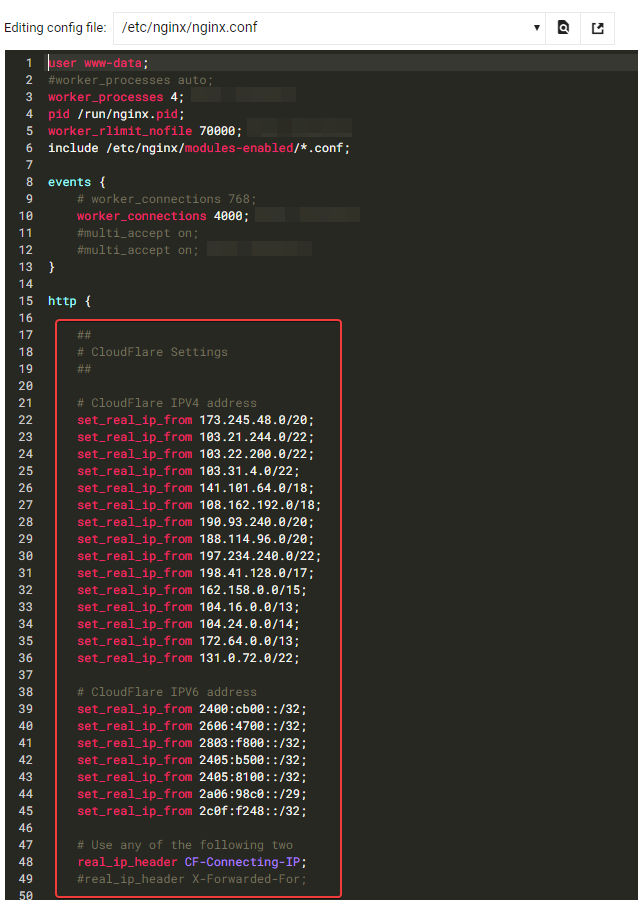
It seems to be good for you ?
PW and WS Spirit alive
-
I have activate ngx_http_realip_module on /etc/nginx/nginx.conf on http block like this :
It seems to be good for you ?
@DownPW yes, that looks fine.
Mark Cutting also advises organisations as a Fractional CIO, Fractional CISO and Executive Advisor, helping boards improve technology governance, cyber resilience and executive decision making. Learn more at Phenomlab Ltd
-
PW and WS Spirit alive
-
@DownPW I suspect that’s a failure of the socket server to talk to redis, but the NodeBB Devs would need to confirm.
Mark Cutting also advises organisations as a Fractional CIO, Fractional CISO and Executive Advisor, helping boards improve technology governance, cyber resilience and executive decision making. Learn more at Phenomlab Ltd
-
@DownPW I suspect that’s a failure of the socket server to talk to redis, but the NodeBB Devs would need to confirm.
Seems to be better with some scaling fix for redis on redis.conf. I haven’t seen the message yet since the changes I made
# I increase it to the value of /proc/sys/net/core/somaxconn
tcp-backlog 4096


# I'm uncommenting because it can slow down Redis. Uncommented by default !!!!!!!!!!!!!!!!!!!
#save 900 1
#save 300 10
#save 60 10000
If you have other Redis optimizations. I take all your advice
-
 undefined DownPW has marked this topic as solved on



Hello! It looks like you're interested in this conversation, but you don't have an account yet.
Getting fed up of having to scroll through the same posts each visit? When you register for an account, you'll always come back to exactly where you were before, and choose to be notified of new replies (either via email, or push notification). You'll also be able to save bookmarks and upvote posts to show your appreciation to other community members.
With your input, this post could be even better 💗
Register Login